2ann · REFERENCE
Driver types
A driver turns electrical signals into sound. These sections distinguish operating principles, fabrication, transmission and combinations. Type and count alone do not rank sound quality.
Understand how sound is made
- DynamicDD · Operating principle
- Balanced armatureBA · Operating principle
- Planar magneticPLANAR · Operating principle
- Electrostatic · ESTEST / ES · Operating principle
- PiezoelectricPZT · Operating principle
- MEMS microspeakerMEMS · Fabrication
- Bone / contact conductionBC · Transmission
- Air Motion TransformerAMT · Operating principle
- Hybrid · TribridHYBRID · Configuration
Dynamic
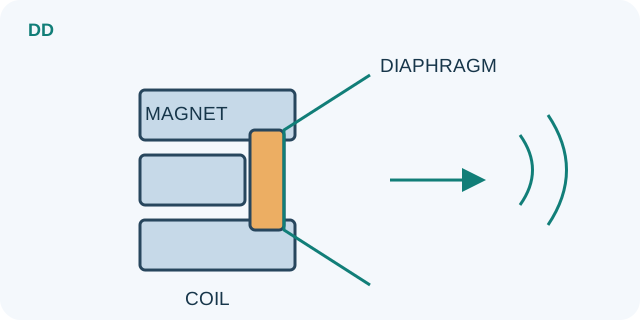
How it works
Current in a voice coil interacts with a magnetic field. The attached diaphragm moves back and forth to move air.
Characteristics
A single driver can cover a wide band. Diaphragm area and excursion provide useful options for bass design.
What to check
Seal, vents and tuning affect bass. A DD does not inherently mean heavy bass or weak treble.
Technical sources: Bose · Driver types ↗
Balanced armature
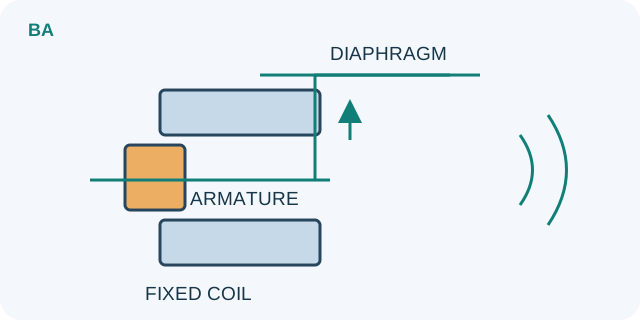
How it works
A fixed coil changes magnetic forces on a small armature between magnets. A linkage transfers its motion to a diaphragm.
Characteristics
Compact packaging supports dedicated frequency bands and multi-driver designs.
What to check
BA units can serve bass, mids or treble. Check crossover integration, acoustic tubes and measured response rather than counting drivers.
Technical sources: Knowles · Balanced armature speakers ↗ · Bose · Driver types ↗
Planar magnetic
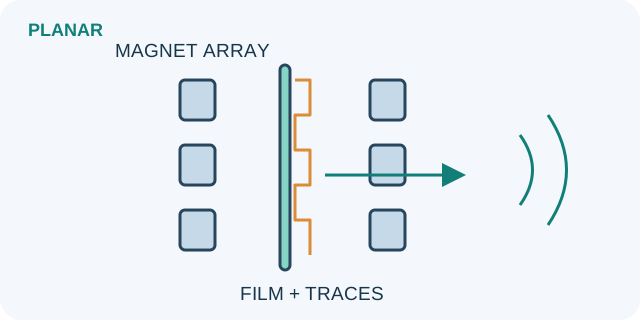
How it works
Current flows through conductive traces on a thin membrane. A magnet array applies force over the driven areas of that membrane.
Characteristics
The design distributes driving force across the membrane rather than using an attached voice-coil assembly.
What to check
Sensitivity and power needs vary. Planar construction alone does not guarantee resolution or difficult amplification.
Technical sources: Audeze · Planar magnetic technology ↗
Electrostatic · EST
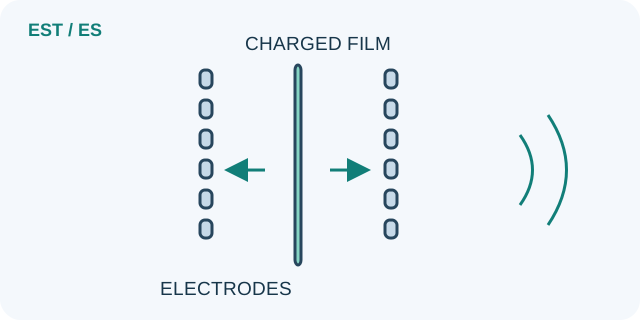
How it works
A charged thin membrane moves in response to changing electric forces between electrodes, rather than a magnetic voice-coil force.
Characteristics
IEM EST units often supplement treble. Full-range electrostatic earphones may instead require a dedicated energizer.
What to check
An EST label does not mean a full-range electrostatic system. Verify its frequency role and drive requirements.
Technical sources: Shure · KSE1500 ↗ · FiiO · FX15 (DD + BA + EST) ↗
Piezoelectric
How it works
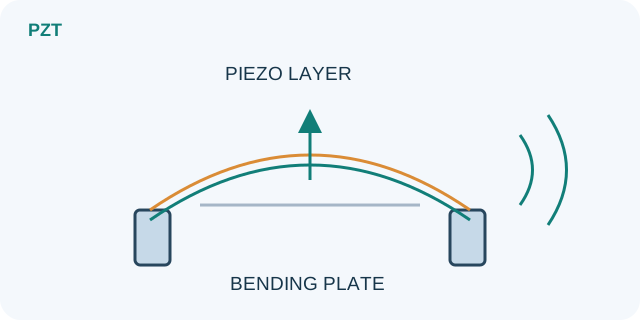
Applied voltage changes the shape of a piezoelectric material. This deformation drives a vibrating surface; the sketch shows a bending plate example.
Characteristics
Thin designs are possible without magnets or voice coils; some earphones use them to supplement high frequencies.
What to check
Resonance, crossover integration and drive circuitry matter more than a ceramic or multilayer label alone.
Technical sources: Murata · Piezoelectric principle ↗
MEMS microspeaker
How it works
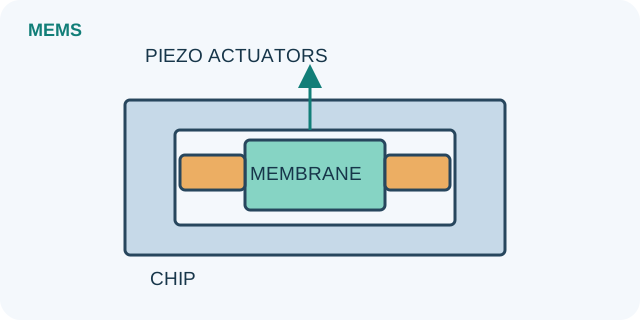
Micromachined structures convert electrical input into sound. The diagram shows a piezoMEMS actuator example, not every MEMS implementation.
Characteristics
Manufacturing enables compact, precise structures. MEMS describes fabrication and can overlap with piezoelectric operation.
What to check
Check the drive electronics, frequency coverage and companion drivers; the label alone does not establish compatibility.
Technical sources: USound · MEMS principle ↗
Bone / contact conduction
How it works
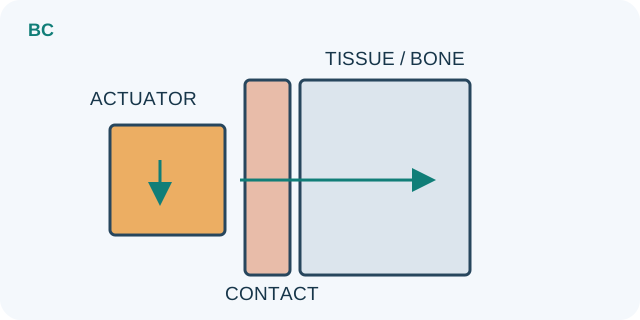
A transducer transfers mechanical vibration through contact with skin, tissue and bone. Its actuator may itself be electromagnetic or piezoelectric.
Characteristics
Distinguish open-ear bone-conduction devices from IEMs combining air and contact transmission.
What to check
Fit, contact position and pressure matter. A BC label does not mean an IEM leaves the ear canal open.
Technical sources: Shokz · Bone conduction ↗ · FiR Audio · Hybrid conduction ↗
Air Motion Transformer
How it works
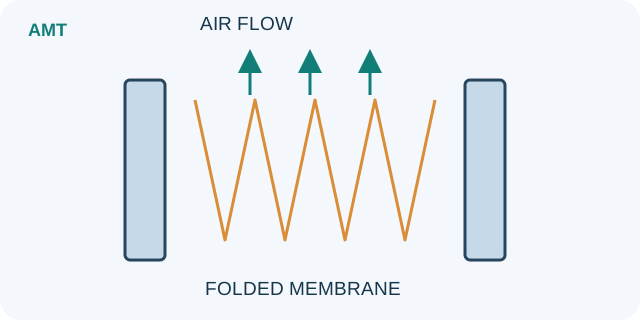
Conductive traces on a folded membrane interact with a magnetic field. The folds open and close, moving air between them.
Characteristics
Folding provides effective diaphragm area; its motion differs from a flat planar membrane.
What to check
Uncommon in earphones. Miniaturization, bandwidth and sensitivity depend on implementation, not the AMT name alone.
Technical sources: HEDD · AMT ↗
Hybrid · Tribrid
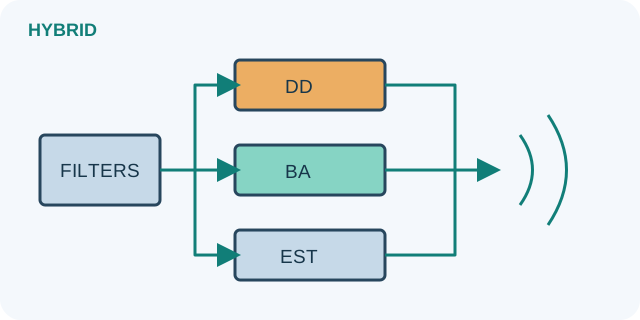
How it works
Different driver types share the work. A DD, BA and EST may cover different bands, combined through electrical and acoustic filtering.
Characteristics
A tribrid usually combines three types, not necessarily three physical drivers.
What to check
Driver count differs from crossover-way count. Compare the finished integration of levels, phase, timing and fit.
Technical sources: FiiO · FX15 (DD + BA + EST) ↗